
The transfer of technology in Argentina’s energy sector accelerates energy transition, enhances industrial competitiveness, and fortifies local manufacturing capabilities. The procedure entails transferring technical knowledge, engineering skills, operational frameworks, and cutting-edge energy technologies from global companies. Technology transfer rises as a result of renewable growth, grid upgrades, hydrogen innovation, battery production, and industrial decarbonization. Argentina’s National Institute of Industrial Property has recently passed a resolution to allow a new regulation for the registration of technology transfer agreements. This will enable global companies to collaborate with local engineering firms, universities, and manufacturers. Technology transfer contributes to developing local industrial capabilities that can create, produce, manage, and export innovative energy solutions. The transfer of technology will depend on utilizing strong power line hardware parts, including the Y-clevis eye
The fork clevis eye enables mechanical connection, load distribution, and structural support in projects ranging from solar parks to shale operations and lithium mining. The Y-clevis eye design ensures durability in harsh environmental conditions. It provides a reliable interface for transferring mechanical loads through a structural system. This prevents localized stress concentrations and ensures stability. The Y-shaped design allows for limited rotation and articulation between connected parts. The design also allows for vertical change and precise alignment during installation. It creates strong, secure, and often pivotable connection points. It links components like rotating torque tubes to drive systems in solar parks, attaches insulators to transmission poles, and provides secure rigging points for lifting heavy equipment.
Quality assurance for Y-clevis eyes used in energy technology
The Y-clevis eye serves as a critical mechanical connection component in transmission and distribution infrastructure. Conducting quality assurance ensures the components maintain mechanical stability under high operational stress. The Y-clevis eye connects insulators, suspension assemblies, conductor hardware, and structural fittings. Quality assurance prevents failures that can lead to insulator string collapse, conductor detachment, transmission outages, and structural instability. Poor quality fittings experience stress cracking, pin deformation, corrosion-related weakening, fracture under load, and excessive wear at articulation points. The QA process includes raw material verification, manufacturing quality control, dimensional accuracy inspection, mechanical strength testing, and non-destructive testing. Reliable Y-clevis eye performance contributes to transmission system stability, insulator string integrity, conductor support reliability, and reduced outage frequency. High-quality QA processes support energy security, infrastructure resilience, and safe power delivery.
Impacts of using Y-clevis eye in technology transfer in Argentina’s energy sector
The Y-clevis eye supports the physical implementation of the transferred technologies in Argentina. They are crucial components as the country adopts advanced grid technologies, renewable integration systems, and modernized transmission infrastructure. The clevis eye enables reliable mechanical connectivity across complex electrical networks. Here are the key functions of the Y-clevis eye in the technologies.
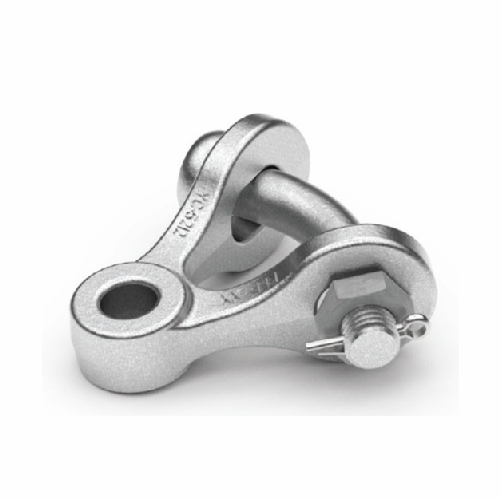
- Supporting modern transmission infrastructure—the Y-clevis eyes in technology transfer support upgraded transmission line systems. The clevises connect the systems by linking suspension insulators, tower fittings, deadend hardware, and mechanical conductor assemblies.
- Enabling renewable energy integration—Y-clevis eyes serve in renewable evacuation lines, insulator suspension assemblies, and renewable substation interconnections. They ensure reliable mechanical support for transmitting renewable electricity into the interconnected grid.
- Supporting smart grid deployment—smart grids improve real-time grid monitoring, automated fault response, and dynamic load balancing. Y-clevis eyes support modern systems by maintaining secure articulation points in mechanical assemblies.
- Easing high-voltage interconnection projects—Y-clevis eyes serve in high-voltage suspension systems, cross-border interconnection infrastructure, and utility-scale transmission lines. Y-clevis eyes improve system interoperability and project qualification.
- Improving mechanical reliability through advanced manufacturing—the Y-clevis eye improves structural consistency, load-bearing performance, and corrosion resistance.
Technology transfer in Argentina’s energy sector
The transfer of technology in Argentina relies on the application of advanced energy technologies that enhance renewable integration, grid stability, industrial effectiveness, and energy security. These technologies are shared via collaborations among international technology suppliers, utility companies, EPC contractors, and domestic manufacturers. Argentina has some of the biggest resources globally for generating renewable energy. Many of the prevalent technologies facilitating the transfer comprise wind energy systems, solar PV systems, battery energy storage systems (BESS), smart grid systems, high-voltage transmission systems, electric mobility systems, hydrogen systems, direct lithium extraction methods, as well as grid connection and distribution systems.
The transfer of advanced energy technologies aids Argentina in its objectives of enhancing renewable energy, upgrading infrastructure, and promoting decarbonization. The transfer enhances technical workforce growth, engineering skills, research potential, and regional manufacturing abilities. These technologies will change Argentina from an exporter of energy resources to a regional hub for advanced energy generation, infrastructure growth, and clean energy innovation